Thursday, February 2, 2012

Black History Makers: Thurgood Marshall


In the long history of uphill struggle for blacks in America, there are many notable firsts. In addition black history is populated with some truly notable black heroes who made significant contributions to the prosperity of African Americans and the kind of change that brings about full citizenship and acceptance for African Americans at every tier of society. One such American hero was Thurgood Marshall.

The bare facts of the rise of this black leader don’t say enough about the tremendous influence his work did to improve race relations in this country. Thurgood was the great grandson of a slave and his father did well to educate the boy in the value of education and of the law in modern society. His brilliant school career which culminated in graduating Magnum Cum Laud from Howard University was the launch of just a brilliant legal career.

Throughout his time as a lawyer, Marshall’s success in arguing anti segregation and discrimination cases was phenomenal. As chief council for the NAACP, Marshall argued before the Supreme Court 29 times, winning each case he took on. Later when he served in the circuit court, he made 112 rulings that were all fully upheld by the Supreme Court.

But there can be no more phenomenal moment in the life of Thurgood Marshall or in black history itself as when in 1967, President Lyndon Johnson appointed Thurgood Marshall to the Supreme Court. This appointment represented a long uphill climb to see African American leaders take on significant roles of influence in the local, state and federal governments throughout America. For all of the violent social protests and struggles “on the streets” in the sixties and seventies lead by notable black leaders such as Martin Luther King and Malcolm X, it can be argued that the lasting influence Thurgood Marshall in his time on the Supreme Court made just as much impact to improve the lives of black Americans as any other leader of his time.

When you look at the time frame that Thurgood Marshall demonstrated his leadership at a national level, this was a watershed time period in which he made great strides to take this country from one still being affected by the attitudes and social systems of slavery and a past full of discrimination to a society on a clear path to become a truly integrated society of the future.

There can really be no greater single accomplishment that Thurgood Marshall made than his victory in the Brown versus the Board of Education case. It was the success in the case that effectively brought school segregation to a halt once and for all in America. While there was still work to be done to make that legal reality one that was part of the lives of all Americans, Thurgood Marshall opened the door for all African Americans to find the same level of high educational excellence that he role modeled for black youth of his day. In doing so, the economic standard of living and educational level of black America rose significantly throughout his time on the bench giving rise to the first black middle class that only added to the movement of the integration of society across all tiers and situations.

It is for these many good reasons that we would include Thurgood Marshall among the truly great heroes of black history of the last one hundred years. His contribution to the court and the changes in the legal status of Blacks and all minorities and underprivileged people in this country has made America a better place to live for all. He has set a standard for future black leadership and indeed for all of us to live up to the best of our values to see to it that equality and justice for all persons in our society continues to be the rule of law in this country for a long time to come.


Copied with permission from: http://plrplr.com/81079/thurgood-marshall/

Wednesday, February 1, 2012

To My Old Master .... (a letter from a freed slave to his former master)


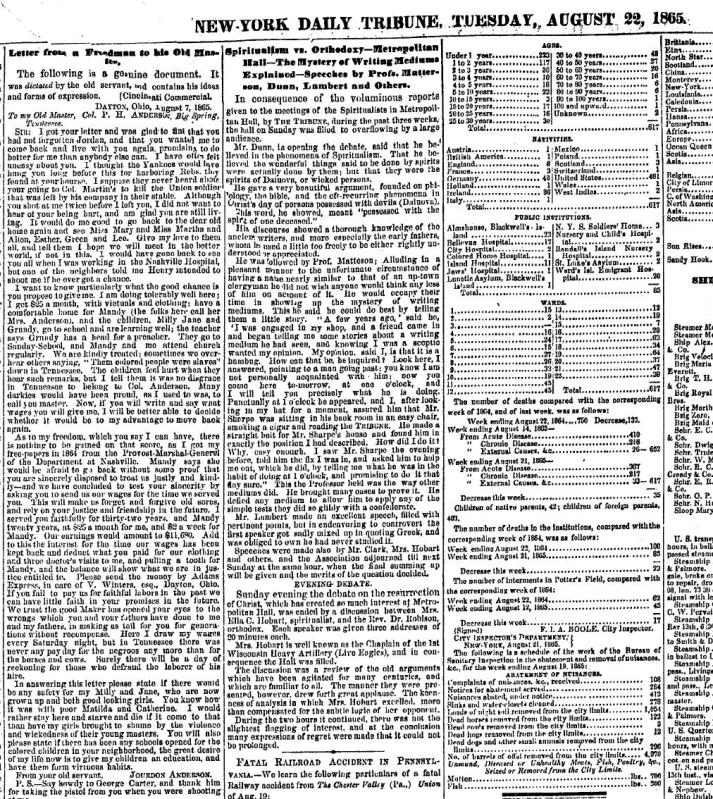
In August of 1865, a Colonel P.H. Anderson of Big Spring, Tennessee, wrote to his former slave, Jourdan Anderson, and requested that he come back to work on his farm. Jourdan — who, since being emancipated, had moved to Ohio, found paid work, and was now supporting his family — responded spectacularly by way of the letter seen below (a letter which, according to newspapers at the time, he dictated).

Rather than quote the numerous highlights in this letter, I'll simply leave you to enjoy it. Do make sure you read to the end.

(Source: The Freedmen's Book; Image: A group of escaped slaves in Virginia in 1862, courtesy of the Library of Congress.)


Dayton, Ohio,

August 7, 1865

To My Old Master, Colonel P.H. Anderson, Big Spring, Tennessee

Sir: I got your letter, and was glad to find that you had not forgotten Jourdon, and that you wanted me to come back and live with you again, promising to do better for me than anybody else can. I have often felt uneasy about you. I thought the Yankees would have hung you long before this, for harboring Rebs they found at your house. I suppose they never heard about your going to Colonel Martin's to kill the Union soldier that was left by his company in their stable. Although you shot at me twice before I left you, I did not want to hear of your being hurt, and am glad you are still living. It would do me good to go back to the dear old home again, and see Miss Mary and Miss Martha and Allen, Esther, Green, and Lee. Give my love to them all, and tell them I hope we will meet in the better world, if not in this. I would have gone back to see you all when I was working in the Nashville Hospital, but one of the neighbors told me that Henry intended to shoot me if he ever got a chance.

I want to know particularly what the good chance is you propose to give me. I am doing tolerably well here. I get twenty-five dollars a month, with victuals and clothing; have a comfortable home for Mandy,—the folks call her Mrs. Anderson,—and the children—Milly, Jane, and Grundy—go to school and are learning well. The teacher says Grundy has a head for a preacher. They go to Sunday school, and Mandy and me attend church regularly. We are kindly treated. Sometimes we overhear others saying, "Them colored people were slaves" down in Tennessee. The children feel hurt when they hear such remarks; but I tell them it was no disgrace in Tennessee to belong to Colonel Anderson. Many darkeys would have been proud, as I used to be, to call you master. Now if you will write and say what wages you will give me, I will be better able to decide whether it would be to my advantage to move back again.

As to my freedom, which you say I can have, there is nothing to be gained on that score, as I got my free papers in 1864 from the Provost-Marshal-General of the Department of Nashville. Mandy says she would be afraid to go back without some proof that you were disposed to treat us justly and kindly; and we have concluded to test your sincerity by asking you to send us our wages for the time we served you. This will make us forget and forgive old scores, and rely on your justice and friendship in the future. I served you faithfully for thirty-two years, and Mandy twenty years. At twenty-five dollars a month for me, and two dollars a week for Mandy, our earnings would amount to eleven thousand six hundred and eighty dollars. Add to this the interest for the time our wages have been kept back, and deduct what you paid for our clothing, and three doctor's visits to me, and pulling a tooth for Mandy, and the balance will show what we are in justice entitled to. Please send the money by Adams's Express, in care of V. Winters, Esq., Dayton, Ohio. If you fail to pay us for faithful labors in the past, we can have little faith in your promises in the future. We trust the good Maker has opened your eyes to the wrongs which you and your fathers have done to me and my fathers, in making us toil for you for generations without recompense. Here I draw my wages every Saturday night; but in Tennessee there was never any pay-day for the negroes any more than for the horses and cows. Surely there will be a day of reckoning for those who defraud the laborer of his hire.

In answering this letter, please state if there would be any safety for my Milly and Jane, who are now grown up, and both good-looking girls. You know how it was with poor Matilda and Catherine. I would rather stay here and starve—and die, if it come to that—than have my girls brought to shame by the violence and wickedness of their young masters. You will also please state if there has been any schools opened for the colored children in your neighborhood. The great desire of my life now is to give my children an education, and have them form virtuous habits.

Say howdy to George Carter, and thank him for taking the pistol from you when you were shooting at me.

From your old servant,

Jourdon Anderson.

Tuesday, February 15, 2011

Little Known Black History Fact ... Eleanor Roosevelt / Mary McLeod Bethune


In 1938, First Lady Eleanor Roosevelt challenged the segregation rules at the Southern Conference on Human Welfare in Birmingham, Alabama, so she could sit next to African-American educator Mary McLeod Bethune, whom she referred to as "her closest friend in her age group."

Black History Makers: Henry Louis Gates, Jr - Educator, author, editor

Henry Louis Gates, Jr.  (1950 - )

Educator, author, editor. Born on September 16, 1950, in Keyser, West Virginia. Gates excelled as a student, graduating from Yale University in 1973 with a degree in history. He continued his education at Clare College, which is part of Cambridge University in England. He finished his doctorate degree in 1979, making him the first African-American to receive a Ph.D. from the university.

In the 1980s Gates became known as a leading scholar of African-American literature, history, and culture. He built his reputation in part on his talents as a researcher. At the start of the decade, he began working on the Black Periodical Literature Project, which uncovered lost literary works published in 1800s. Gates received a grant from the prestigious MacArthur Foundation in 1981, which helped support his scholarship in African-American literature. He had rediscovered what is believed to be the first novel published by an African-American in the United States. Gates republished the 1859 work by Harriet E. Wilson entitled Our Nig in 1983. 

Gates served an editor on several anthologies and collections of African-American literature and contributed to the field of literary theory with such works as Black Literature and Literary Theory (1984) and The Signifying Monkey: Towards a Theory of Afro-American Literary Criticism (1988). In 1991, Gates became the head of the African-American studies department at Harvard University. He is credited with transforming the school's African American studies program. Gates is now the director of the W. E. B. Du Bois Institute for African and African-American Research at the university.

Recently, Gates has been involved in a number of interesting educational projects for television. He wrote and produced several documentaries: Wonders of the African World (2000), America Beyond the Color LineAfrican American Lives (2006). Gates has plans for more documentaries, including a documentary special on the heritage of talk show host Oprah Winfrey and a sequel to African American Lives. (2004), and

Gates has also earned numerous honors. In addition to his MacArthur Fellowship, he was chosen by the National Endowment for the Humanities to give the Jefferson Lecture, was inducted into the Sons of the American Revolution in 2006, and named as one of Time magazine's 25 Most Influential Americans in 2007. He also has more than 50 honorary degrees.

Gates returned to the public eye in July 2009, when a police officer responded to a call reporting a break-in at the Gates home Cambridge, Massachusetts. In reality, Gates and his African-American driver were attempting to get into the house after having trouble with the door. Reports conflict on the what happened next: some say that the officer refused to identify himself after Gates asked for his name and badge number, while others say that Gates refused to answer the officer's questions and became disorderly after he believed the policer officer was guilty of racism. In the aftermath of this incident, President Barack Obama said he believed the police had "acted stupidly." The comment opened the president to public criticism on the issue. 

Gates has been married to Sharon Lynn Adams since 1979. Gates and his wife have two daughters, Maude and Elizabeth.

Wednesday, February 9, 2011

The Burning of Greenwood, Oklahoma 1921 - The BLACK Wall Street


Greenwood, Tulsa, Oklahoma

Greenwood was a district in Tulsa, Oklahoma. As one of the most successful and wealthiest African American communities in the United States during the early 20th Century, it was popularly known as America's "Black Wall Street" until the Tulsa Race Riot of 1921. The riot was one of the most devastating race riots in history and it destroyed the once thriving Greenwood community.

The Roots

Many African Americans moved to Oklahoma in the years before and after 1907, which is the year Oklahoma became a state. Oklahoma represented change and provided a chance for African Americans to get away from slavery and the harsh racism of their previous homes. Most of them traveled from the states in the south where racism was very prevalent, and Oklahoma offered hope and provided all people with a chance to start over. They traveled to Oklahoma by wagons, horses, trains, and even on foot.

Many of the African Americans who traveled to Oklahoma had ancestors who could be traced back to Oklahoma. A lot of the settlers were relatives of African American slaves who had traveled on foot with the Five Civilized Tribes along the Trail of Tears. Others were the descendants of runaway slaves who had fled to Indian Territory (present day Oklahoma) in an effort to escape lives of oppression.

When Tulsa became a booming and rather well noted town in the United States, the residents and government attempted to leave out important aspects of the city. Many people considered Tulsa to be two separate cities rather than one city of united communities. The white residents of Tulsa referred to the area north of the Frisco railroad tracks as “Little Africa” and other derogatory names. They felt threatened by the success of the African American community, and worried that it might continue to grow. This community later acquired the name Greenwood and by 1921 it was home to about 10,000 African American men, women, and children.

Greenwood was centered on a street known as Greenwood Avenue. This street was important because it ran north for over a mile from the Frisco Railroad yards, and it was one of the few streets that did not cross through both black and white neighborhoods. The citizens of Greenwood took pride in this fact because it was something they had all to themselves and did not have to share with the white community of Tulsa. Greenwood Avenue was home to the African American commercial district with many red brick buildings. These buildings belonged to African Americans and they were thriving businesses, including grocery stores, clothing stores, barbershops, and much more. Greenwood was one of the most affluent communities and it became known as “Black Wall Street.”

During the oil boom of the 1910s, the area of northeast Oklahoma around Tulsa flourished, including the Greenwood neighborhood, which came to be known as "the Negro Wall Street" (now commonly referred to as "the Black Wall Street")[2] The area was home to several prominent black businessmen, many of them multimillionaires. Greenwood boasted a variety of thriving businesses that were very successful up until the Tulsa Race Riot. Not only did African Americans want to contribute to the success of their own shops, but also the racial segregation laws prevented them from shopping anywhere other than Greenwood. Following the riots, the area was rebuilt and thrived until the 1960s when desegregation allowed blacks to shop in areas that were restricted before.

The buildings on Greenwood Avenue housed the offices of almost all of Tulsa’s black lawyers, realtors, doctors, and other professionals. In Tulsa at the time of the riot, there were fifteen well-known African American physicians, one of whom was considered the “most able Negro surgeon in America” by one of the Mayo brothers. Greenwood published two newspapers, the Tulsa Star and the Oklahoma Sun, which covered not only Tulsa, but also state and national news and elections.

Greenwood was a very religiously active community. At the time of the riot there were more than a dozen African American churches and many Christian youth organizations and religious societies.

In northeastern Oklahoma, as elsewhere in America, the prosperity of minorities emerged amidst racial and political tension. The Ku Klux Klan made its first major appearance in Oklahoma shortly before the worst race riot in history. It is estimated that there were about 3,200 members of the Klan in Tulsa in 1921  .
  
O. W. Gurley (Founder)

Prior to the turn of the century O. W. Gurley, a wealthy African American land-owner from Arkansas, traversed the United States to participate in the Oklahoma Land run of 1889. The young entrepreneur had just resigned from a presidential appointment under president Grover Cleveland in order to strike out on his own." 

In 1906, Gurley moved to Tulsa, Oklahoma where he purchased 40 acres of land which was "only to be sold to colored". Black ownership was unheard of at that time.

Among Gurley's first businesses was a rooming house which was located on a dusty trail near the railroad tracks. This road was given the name Greenwood Avenue, named for a city in Mississippi. The area became very popular among African American migrants fleeing the oppression in Mississippi. They would find refuge in Gurley's building, as the racial persecution from the south was non-existent on Greenwood Avenue.

In addition to his rooming house, Gurley built three two-story buildings and five residences and bought an 80-acre farm in Rogers County. Gurley also founded what is today Vernon AME Church. 

Gurley's implementation of "colored" segregation set the Greenwood boundaries of separateness that exist to this day: Pine Street to the North, Archer Street and the Frisco tracks to the South, Cincinnati Street on the West, and Lansing Street on the East. The segregation is pronounced in subtle landmarks. South of Archer, Greenwood Avenue does not exist in white neighborhoods.

Gurley's prominence and wealth were short lived. In a matter of moments he lost everything. During the race war The Gurley Hotel at 112 N. Greenwood, the street’s first commercial enterprise, valued at $55,000, was lost, and with it Brunswick Billiard Parlor and Dock Eastmand & Hughes Cafe. Gurley also owned a two-story building at 119 N. Greenwood. It housed Carter’s Barbershop, Hardy Rooms, a pool hall, and cigar store. All were reduced to ruins. By his account and court records, he lost nearly $200,000 in the 1921 race war.

Because of his leadership role in creating this self sustaining exclusive black "enclave", it had been falsely rumored that Gurley was lynched by a white mob and buried in an unmarked grave. However, according to the memoirs of Greenwood pioneer B. C. Franklin, Gurley exiled himself to California. The founder of the most successful African American community of his time vanished from the history books and drifted into obscurity. He is now being honored in a recently released documentary film, called "Before They Die! The Road to Reparations for the 1921 Tulsa Race Riot Survivors".

The Tulsa Race Riot

One of the nation's worst acts of racial violence, the Tulsa Race Riot, occurred there on June 1, 1921, when 35 square blocks of homes and businesses were torched by mobs of angry whites.

The riot began because of an alleged assault of a white woman, Sarah Page, by an African American man, Dick Rowland. The Tulsa Tribune got word of the incident and published the story in the paper on May 31, 1921. Shortly after the newspaper article surfaced, there was news that a white lynch mob was going to take matters into its own hands and kill Dick Rowland.

African American men began to arm themselves and join forces in order to protect Dick Rowland. Subsequently, white men armed themselves and confronted the group of African American men. There was an argument in which a white man tried to take a gun from a black man, and the gun fired a bullet up into the sky. This incident promoted many others to fire their guns, and the violence erupted on the evening of May 31, 1921. Whites flooded into the Greenwood district and destroyed the businesses and homes of African American residents. No one was exempt to the violence of the white mobs; men, women, and even children were killed by the mobs. In an effort to completely destroy the Greenwood District of Tulsa, firemen were held at gunpoint by whites making it impossible to put out the flames.

Troops were eventually deployed on the afternoon of June 1, but by that time there was not much left of the once thriving Greenwood district. Over 600 successful businesses were lost. Among these were 21 churches, 21 restaurants, 30 grocery stores and two movie theaters, plus a hospital, a bank, a post office, libraries, schools, law offices, a half-dozen private airplanes and even a bus system. Property damage totaled $1.5 million (1921). Although the official death toll claimed that 26 blacks and 13 whites died during the fighting, most estimates are considerably higher. At the time of the riot, the American Red Cross listed 8,624 persons in need of assistance, in excess of 1,000 homes and businesses destroyed, and the delivery of several stillborn infants. 

Post riot

The community mobilized its resources and rebuilt the Greenwood area within five years of the Tulsa Race Riot and the neighborhood was a hotbed of jazz and blues in the 1920s. However, the neighborhood fell prey to an economic and population drain in the 1960s, and much of the area was leveled during urban renewal in the early 1970s to make way for a highway loop around the downtown district. Several blocks around the intersection of Greenwood Avenue and Archer Street were saved from demolition and have been restored, forming part of the Greenwood Historical District.

Greenwood Cultural Center

The Greenwood Cultural Center, dedicated on October 22, 1995, was created as a tribute to Greenwood’s history and as a symbol of hope for the community’s future. The center has a museum, an African American art gallery, a large banquet hall, and also the Oklahoma Jazz Hall of Fame. The total cost of the center was almost $3 million. The cultural center is a very important part of the reconstruction and unity of the Greenwood Historical District.

The Greenwood Cultural Center sponsors and promotes education and cultural events preserving African American heritage. It also provides positive images of North Tulsa to the community, attracting a wide variety of visitors, not only to the center itself, but also to the city of Tulsa as a whole.

Sunday, February 6, 2011

Black History Makers: Mike Tomlin - Head Coach Pittsburgh Steelers

Mike Tomlin

Mike Tomlin was named the 16th head coach in Pittsburgh Steelers history on Jan. 22, 2007. Hired at the age of 34, Tomlin became only the third head coach hired by the Steelers since 1969.

Tomlin became the youngest head coach in NFL history to both coach in and win a Super Bowl when he led the Steelers to a 27-23 victory over the Arizona Cardinals in Super Bowl XLIII. By winning the Super Bowl in only his second season as a head coach, he also became the fastest to win a Super Bowl title in Steelers history.

Tomlin is one of only seven coaches in league history to win a Super Bowl within his first two seasons as an NFL head coach.

Tomlin has compiled a 31-17 record in the regular season during his three-year head coaching career. His .646 winning percentage after three seasons is second-best in team history. By leading the Steelers to a 9-7 record in 2009, Tomlin became only the second Steelers’ head coach to post winning records after each of his first three seasons.

The Steelers’ offense ranked seventh in the NFL (ninth passing, 19th rushing) and became the first unit in team history to boast a 4,000-yard passer, two 1,000-yard receivers and a 1,000-yard rusher in the same season. Pittsburgh’s defense ranked fifth in the NFL (third vs. run, 16th vs. pass) while leading the AFC and finishing one shy of the NFL lead with 47 quarterback sacks.

The Steelers continued to be dominant at Heinz Field under Tomlin in 2009. Pittsburgh finished with a 6-2 home record in 2009 after finishing 7-1 (2007) and 6-2 (2008) at home during Tomlin’s first two seasons. Tomlin’s 19-5 record and .792 winning percentage at home after three seasons ranks second in Steelers’ history.

Tomlin finished the 2008 season with a 12-4 record and his second consecutive AFC North Division title, becoming the only Steelers head coach to win division crowns in each of his first two seasons. He also set a record with 22 regular-season wins in his first two years at the helm and is the only Steelers head coach to win at least 10 games in each of his first two seasons. Tomlin’s .688 winning percentage (22-10) after two years is the best in Steelers history.

The Steelers’ defense was dominant under Tomlin’s guidance in 2008, leading the NFL in total defense (237.2), pass defense (156.9), points per game (13.9), total yards per play (3.9), rushing yards per attempt (3.3), passing yards per attempt (4.7) and third down efficiency (31.4), and finished second in league rushing defense (80.3).

Tomlin led the Steelers to a 10-6 record in 2007, and became just the second coach in team history to post a winning record, win a division title and earn a playoff berth in his inaugural season.

Tomlin guided the Steelers to the NFL’s top-ranked defense in 2007, yielding only 266.4 yards per game. The Steelers’ defense ranked third in the NFL against both the run (89.9 avg.) and pass (176.5 avg.), and also finished third in the league in total yards allowed per play (4.6). Pittsburgh’s defense led the NFL in passing yards per play (5.7) and first downs allowed per game (15.6), and finished second in the league in points allowed per game (16.8).

The Steelers’ offense finished third in the NFL in rushing (135.5 avg.) during Tomlin’s first season, sparked by RB Willie Parker who led the league in rushing before injuring his leg in Week 16. Steelers QB Ben Roethlisberger enjoyed a record-setting season during Tomlin’s first year, establishing new team records for touchdown passes (32) and passer rating (104.1), while earning his first career Pro Bowl appearance. In 2007, the Steelers held the advantage in time of possession in 14-of-16 regular season games.

Tomlin was the NFL’s second-youngest head coach in 2007, and he became only the second Steelers coach in team history to win at least 10 games during his first year at the helm. The Steelers posted a 7-1 record at home in 2007 and were 5-1 in the AFC North (3-0 at home).

Tomlin became only the second Steelers head coach to win his first three games. During 2007, the Steelers became just the fifth team in NFL history to win their first four home games by at least 20 points.

Tomlin spent the 2006 season as the Minnesota Vikings’ defensive coordinator after spending the previous five seasons (2001-05) as defensive backs coach for the Tampa Bay Buccaneers.

Under Tomlin in 2006, the Vikings ranked eighth in the NFL in total defense and first against the run while not allowing a 100-yard rusher the entire season. They held the Detroit Lions to minus-three yards rushing while playing on the road (Dec. 10).

Prior to his one season in Minnesota, Tomlin was the defensive backs coach for five seasons for one of the NFL’s top defenses in Tampa Bay. Tomlin’s defensive backs earned numerous honors for their play during his coaching tenure. In 2005 Tampa Bay led the NFL in total defense, allowing 277.8 yards per game, and finished 6thin the league against the pass (183.1 avg.).

In 2002 Tomlin guided one of the most productive defensive backfields in the NFL, culminating with its performance in Super Bowl XXXVII. The secondary recorded four of the team’s five interceptions, returning two for touchdowns to help Tampa Bay capture the franchise’s first Super Bowl title.

Before joining Tampa Bay’s staff, Tomlin served two seasons as the defensive backs coach at the University of Cincinnati (1999-00). He took over a secondary that ranked 111thin the nation in pass defense in 1998 and helped them improve to 61stoverall in his first season in ’99. Under Tomlin’s direction in 2000, the Bearcats ranked eighth in the nation in interceptions as well as fourth nationally in total turnovers.

Prior to joining the Cincinnati staff, Tomlin had a short stint on the coaching staff at Tennessee-Martin and then spent two seasons at Arkansas State where he coached wide receivers in 1997 before switching to defensive backs in 1998. Tomlin spent the 1996 season as a graduate assistant at the University of Memphis, where he worked with the Tiger defensive backs and special teams units. He began his coaching career in 1995 as wide receivers coach at Virginia Military Institute.

Tomlin was a three-year starter at wide receiver at William and Mary (1990-94) and finished his career with 101 receptions for 2,046 yards and a school-record 20 TD catches. A first-team All-Yankee Conference selection in 1994, he established a school record with a 20.2 yards-
per-catch average.

Friday, February 4, 2011

Black History Makers: Russell Simmons - Entrepreneur and Philanthropist

Russell Simmons(1957 – )

Entrepreneur, philanthropist. Born October 4, 1957 in New York City. After a brief stint at City College of New York, Russell Simmons left school to promote local musicians, including Kurtis Blow and Run-D.M.C. In 1984, he and partner Rick Rubin founded Def Jam Recordings, creating the foundation for the cultural revolution known as hip hop. Def Jam signed the forerunners of the hip hop movement, including the Beastie Boys, LL Cool J, Public Enemy and Run-D.M.C.

An ambitious entrepreneur, Simmons saw Def Jam as just part of his hip hop empire. His Rush Communications firm also included Phat Farm clothing company, television shows, a management company, a magazine and an advertising agency. His movie production house has produced such films as Krush GrooveThe Nutty Professor. In 1999, he sold his stake in Def Jam Records to Universal Music Group for $100 million. In 2004, he sold Phat Farm for $140 million. 

A strict vegan and yoga enthusiast, Simmons is also an active philanthropist. He helped found the Hip Hop Summit Action Network, the Rush Philanthropic Organization and the Foundation for Ethnic Understanding. He actively supports PETA and was named a Goodwill Ambassador to fight war, poverty and HIV/AIDS. He is the author of Do You! 12 Laws To Access The Power In You To Achieve Happiness And Success.

Simmons was married to model Kimora Lee from 1998 to 2008. They have two daughters, Ming and Aoki.